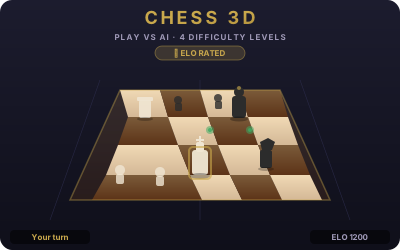
About Chess 3D
Chess 3D is full-rules chess on a board you can rotate, played against an engine with four calibrated strengths. The rules are complete rather than approximate: castling on both sides with the standard rights tracking, en passant, pawn promotion, stalemate as a draw, and position-repetition detection that accounts for side to move, castling rights and the en passant square - which is the part most browser chess games skip and the reason their draw detection is wrong. The four AI levels are set at 600, 1100, 1500 and 1900 Elo, which are real rating targets rather than labels: 600 plays like a beginner who sees one move ahead, and 1900 is a strong club player. Your own rating starts at 800 and moves after every game using the standard Elo expectation curve, so beating the 1900 engine is worth a great deal more than beating the 600 one, and losing to the 600 costs accordingly. The rating is stored in your browser and persists between sessions. The board renders in 3D and can be turned to any angle, which matters more than it sounds - looking down a diagonal is a genuinely different way to see a position than reading it from directly above.
How to Play Chess 3D
Pick a difficulty - 600, 1100, 1500 or 1900 Elo - and play as white. Tap or click a piece to select it, and its legal moves are shown on the board; tap a highlighted square to move there. Castling is done by moving the king two squares toward the rook, en passant is offered as a normal legal move when it applies, and a pawn reaching the last rank prompts for promotion. Drag to rotate the board to any angle you like. The game ends in checkmate, stalemate, or a draw by threefold repetition, and your Elo rating updates afterwards based on the engine's rating and the result - so the strength you choose to play at is itself a decision about what a win is worth.
Chess 3D Tips and Strategy
- Your rating starts at 800, which sits between the 600 and 1100 engines. Playing the 600 repeatedly will barely move it, because the Elo expectation curve pays almost nothing for a win you were expected to get
- The rating change scales with the gap, so one win against the 1500 engine moves you further than a long streak against the 600 - and one loss to the 600 costs more than a loss to the 1900
- Rotate the board when a position stops making sense. Diagonal threats and back-rank problems are far easier to see from a low angle along the file than from a top-down view
- Repetition detection here is proper - it accounts for side to move, castling rights and the en passant square - so a position that looks repeated may not be. If you are trying to force a draw, the rights have to match too
- The 1900 engine punishes early queen moves the way a real club player does. Develop knights and bishops and castle before doing anything ambitious with the queen
- Castling rights are tracked separately for each side and each rook, so moving a rook once forfeits that side permanently even if you move it back. On the higher levels the engine will play for that
- Promotion is prompted rather than automatic, so underpromotion to a knight is available when it is the move - which the engine at 1500 and above will find against you
Chess 3D FAQ
Is Chess 3D free to play?
Yes. Chess 3D is free on Weekly Arcade with no downloads, no ads and no account needed to play against the engine. Signing in adds leaderboard submission and achievements.
How strong is the chess AI?
There are four levels set at 600, 1100, 1500 and 1900 Elo. Those are calibrated targets rather than labels - 600 plays like a beginner, 1100 like an improving casual player, 1500 like a solid club player, and 1900 like a strong one.
How does the Elo rating work?
You start at 800 and your rating updates after every game using the standard Elo expectation formula, which compares your rating to the engine's over a 400-point scale. Beating a much stronger engine gains a lot; losing to a much weaker one costs a lot. The rating is stored in your browser.
Does it support all the chess rules?
Yes, including the ones browser chess games usually omit: castling with per-side rights tracking, en passant, pawn promotion with a choice of piece, stalemate as a draw, and threefold-repetition detection that accounts for side to move, castling rights and the en passant square.
Can I rotate the 3D board?
Yes, to any angle. It is not a fixed set of camera presets. This is genuinely useful rather than decorative - diagonal threats and back-rank weaknesses read very differently from a low angle along a file than from directly overhead.
Can I play chess against another person?
Yes. Chess 3D includes online multiplayer alongside the four AI difficulties, so you can play a real opponent rather than the engine.
Does Chess 3D work on mobile?
Yes. Piece selection and movement are taps rather than drags, legal moves are highlighted on selection, and board rotation works with a touch drag. Performance is tuned for phone GPUs.