About Fieldstone
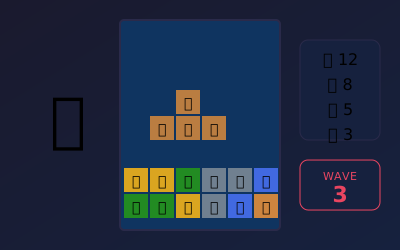
Fieldstone puts a kingdom-builder on top of a falling-block board, and the two halves genuinely interact rather than sitting side by side. You place tetromino pieces on a 10-by-20 grid, but each piece carries terrain rather than colour - forest, plains, mountain, river, settlement, wall or cursed ground - and completing a horizontal row harvests it instead of merely clearing it, paying out gold according to what that row was made of. Rivers pay their full output in gold, mountains a quarter, and cursed tiles are exactly what they sound like. You place ten tiles, and then the round stops being a puzzle: an attack phase resolves, comparing the defence you have built against the enemy's power for that round, and the board you built for economy has to also have been a board that can hold. Gold buys cards between rounds from a deck you chose at the start - farmer opens with a granary, two spearmen and a Bountiful Harvest; mason with a quarry, watchtower, catapult and reinforcements; merchant with a treasury, archers, knights and a terraform. Spells like Siege Break, which removes 50 enemy power for 10 gold, let you buy your way out of one bad round, but only one.
How to Play Fieldstone
Pieces fall as tetrominoes and you place them with the same controls a falling-block game uses - move left and right, rotate, drop. Each piece is made of terrain tiles, and filling a complete horizontal row harvests that row: the tiles are removed and you are paid in gold and score based on what the row contained, with rivers paying their full output and mountains a quarter. After ten placed tiles the round ends and the attack phase begins, comparing your accumulated defence against the round's enemy power. Survive and you keep building; fail and the run ends. Between rounds, gold buys cards from your chosen starting deck - buildings that generate, units that defend, and spells that intervene once.
Fieldstone Tips and Strategy
- Rivers pay their full output as gold while mountains pay a quarter, so a row you can fill with river tiles is worth four times a mountain row of the same length - watch which terrain the next piece carries before deciding where the current one goes
- Ten tiles per round is the real clock, not the board height. You cannot stall for a better piece, so a placement that wastes a tile costs you 10% of the round
- Defence is checked once, at the end of the round, against a single number. Being slightly over the enemy power is exactly as good as being double it, so gold spent past the threshold is gold you should have banked
- The three starting decks are genuinely different strategies rather than flavours: farmer is economy-first, mason buys defence up front, and merchant trades early gold for flexibility with Terraform
- Siege Break costs 10 gold and removes 50 enemy power. That is a whole round bought out of trouble, but it is one card - hold it for the round where your defence is short, not the first one that looks tight
- Cursed tiles do not stop a row completing, so a row with one cursed tile still harvests. Sometimes taking the row and the penalty is better than leaving a hole you can never fill
- Bountiful Harvest doubles the next harvest, so play it before a river row rather than the moment you draw it - the card is worth whatever the row you save it for is worth
Fieldstone FAQ
Is Fieldstone free to play?
Yes. Fieldstone is free on Weekly Arcade with no downloads, no ads and no purchases. Signing in adds leaderboard submission and achievements.
How is Fieldstone different from Tetris?
The board is the same 10-by-20 grid and the pieces are tetrominoes, but completing a row harvests it for gold and score rather than simply clearing it, and the value depends on which terrain the row was made of. You also only place ten tiles per round before an attack phase resolves, so survival is not about how long you can keep stacking.
What happens in the attack phase?
After ten tiles are placed, your accumulated defence is compared against the round's enemy power as a single number. If your defence meets or exceeds it you survive to the next round; if it falls short the run ends. Spells like Siege Break can reduce enemy power before the comparison.
What do the terrain types do?
Seven terrains appear on the pieces - forest, plains, mountain, river, settlement, wall and cursed - and each pays differently when harvested in a completed row. Rivers pay their full output in gold and mountains pay a quarter, so which terrain fills a row matters as much as filling it.
Which starting deck should I pick?
Farmer opens with a granary, two spearmen and Bountiful Harvest, and plays for economy. Mason opens with a quarry, watchtower, catapult and reinforcements, and buys defence early. Merchant opens with a treasury, archers, knights and Terraform, trading early gold for board flexibility.
Can I lose on the board rather than in combat?
The round advances after ten tiles regardless, so the pressure is not the same as a falling-block game where stacking out ends the run. What ends a run is failing the attack phase, which is a consequence of how you spent the board rather than of the board filling up.
Does Fieldstone work on mobile?
Yes. Piece movement, rotation and drop all have touch controls, the 10-by-20 board fits a portrait viewport, and card purchases between rounds are tap targets. It also plays offline once cached.
Games Like Fieldstone
If you enjoy Fieldstone, you might also like: Tetris, Kingdom Rush, Grindstone, Puzzle Quest. Fieldstone is available free on Weekly Arcade - browse all games.
Browse more by genre: arcade games.